
The Death Trap Farakka and Maulana Bhashani's River Philosophy
Machine-translated from Bangla. মূল খবর বাংলায় পড়ুন
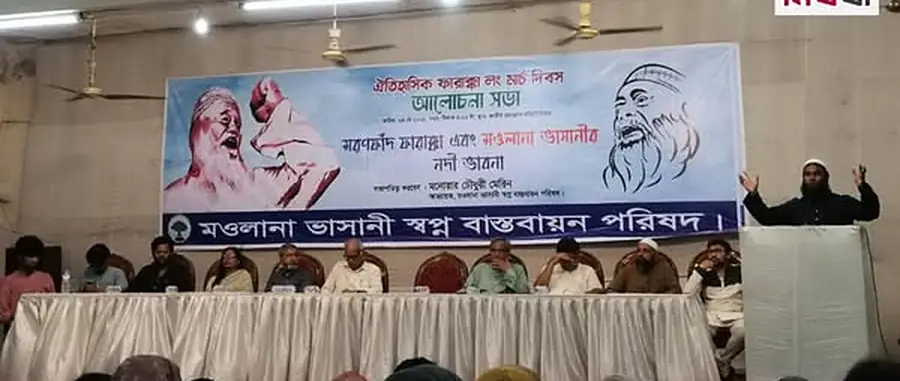
An important discussion meeting titled "The Death Trap Farakka and Maulana Bhashani's River Philosophy" was held today, May 23, at the National Press Club. The meeting, organized by the Maulana Bhashani Smriti Bastobayon Parishad, was presided over by the convenor of the parishad, Monowar Chowdhury Marine. Renowned labor and student movement leaders of the country were present at the meeting.
Taking part in the discussion were Badal Khan, General Secretary of Bangladesh Sromik Jote and pioneer of the Palestine Solidarity Movement; Faiz Hossain, General Secretary of Bangladesh Sromik Federation; Razekuzzaman Ratan, President of Samajtantrik Sromik Front; Shamim Ara, General Secretary of Jatiya Sromik Federation; Fahim Ahmed, Secretary of Ganotantrik Chhatra Council; Meghmallar Basu, President of Bangladesh Chhatra Union, Dhaka University branch; Armanul Haque, Convenor of Bangladesh Chhatra Federation, Dhaka University committee; Sifat Chowdhury, President of the Youth Committee of Bangladesh Labour Federation; and Jahangir Chowdhury, General Secretary of Bangladesh Sanjukta Sromik Federation, along with many other student and labor leaders.
The event was conducted by Ashraful Islam Rana. In their discussions, the speakers highlighted Maulana Bhashani's political life, especially the significance of the river protection movement centered around the historic 1976 Farakka Long March. They said that Bhashani's river philosophy was not merely a call to protect the natural environment, but rather an anti-imperialist struggle. He viewed the river as a living entity—whose flow stopping means the halting of human livelihood, culture, and the sustainable development of the economy.
In the discussion, the speakers criticized India for constructing unilateral dams on 51 out of the 54 shared rivers and diverting the course of the Ganges to protect the Kolkata port. As a result, the navigability of Bangladesh's rivers has decreased, and farmers, boatmen, and river-dependent professionals are losing their livelihoods and moving towards cities. They highlighted this migration as a symbol of social and economic catastrophe. At the same time, the speakers pointed out the harmful impact of the denim apparel industry on Bangladesh's rivers due to the influence of Western capitalist economies.
Rivers are being polluted by industrial waste, and human life and the environment are endangered today. They said that Bhashani's Farakka Long March was essentially a struggle to save human life through the protection of rivers. The movement built under his leadership remains relevant today—because losing the river means losing livelihood, culture, and the national future. The speakers said that Bhashani's politics were not just about elections; he practiced the politics of liberation for society, nature, and humanity.
Guided by the ideology of Hukumat-e-Rabbaniyah, he took a firm stance against imperialist-capitalist aggression to protect the environment and the interests of the people. From the discussion meeting, the younger generation was called upon to join the struggle to realize Bhashani's dream and accelerate the river protection movement. A demand was also raised to ensure public participation in state policies for river conservation.
At the end of the meeting, a cultural evening was organized, where artists from the Cultural Union and national artist Pothik Nobi performed enchanting folk songs. Through songs and melodies, they highlighted the intrinsic relationship between rivers, nature, and human life, which further deepened the significance of the entire event.
This story first appeared on the Prantik News Facebook page.