
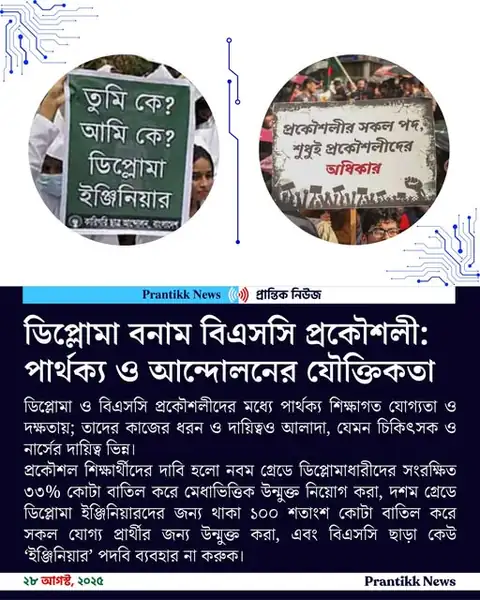
Diploma vs BSc Engineers: Differences and the Rationale Behind Movements
Machine-translated from Bangla. মূল খবর বাংলায় পড়ুন
The differences in educational qualifications and skills between diploma and BSc engineers are distinct. BSc engineers are four- to five-year university degree holders who possess greater theoretical knowledge, design, and problem-solving skills. On the other hand, diploma engineers complete a four-year diploma-in-engineering program. In this course, along with SSC pass students, HSC pass students also get the opportunity to enroll in the fourth semester. As a result, their educational structure is also considered a full-fledged technical higher education stage.
The post of sub-assistant engineer has been reserved for diploma holders since 1876, meaning they have been confined within the engineering sector. A general graduate student easily gets job opportunities in journalism, banking, or other sectors, but a diploma holder cannot apply for any government job other than that of a sub-assistant engineer. At the same time, their opportunities for higher education are also comparatively limited, which has given rise to major discrimination.
In this reality, it is natural for the nature of work and responsibilities of the two types of students to be different—just like the responsibilities of a doctor and a nurse are different. But the core reason for conflict is that diploma holders want special privileges, quotas, and reserved posts, while BSc students want to ensure open and merit-based recruitment.
BSc students are demanding the cancellation of the 33 percent quota reserved for diploma holders in the 9th grade and the 100 percent quota existing for diploma engineers in the 10th grade, and the introduction of open recruitment for all qualified candidates. Alongside this, they are also demanding that the title of 'engineer' be restricted solely to BSc degree holders.
On the other hand, polytechnic students are saying that their illegal promotions must be cancelled, a four-year quality curriculum must be formulated, reservation in the post of sub-assistant engineer must be maintained, and the recruitment of technically educated persons in technical sector posts must be ensured. At the same time, they have also raised demands for the formation of a separate Ministry of Technical Education, the establishment of a technical university, and the ensuring of 100 percent admission in new colleges.
In conclusion, to resolve this conflict, it is essential to create separate career paths through discussions based on educational qualifications and skills, so that both diploma and BSc engineers can work efficiently in their respective responsibilities and a transparent, merit-based opportunity is ensured in government jobs.
This story first appeared on the Prantik News Facebook page.