

Today is 10 Muharram, the holy Ashura
Karbala is not merely a religious event of mourning, it is a symbol of a multidimensional political and social struggle.
Machine-translated from Bangla. মূল খবর বাংলায় পড়ুন
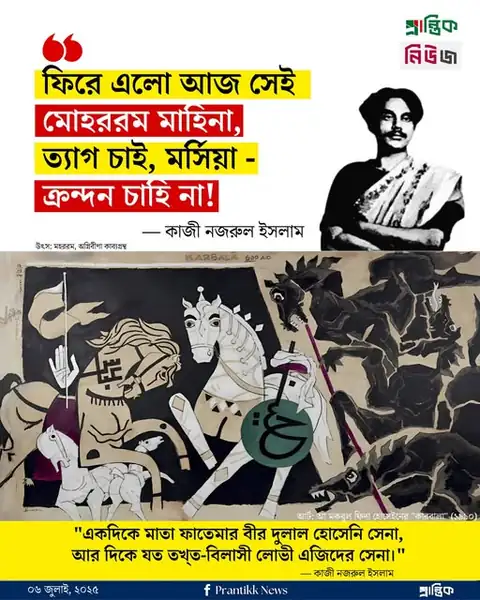
Today is 10 Muharram, the holy Ashura. Karbala is not merely a religious event of mourning, it is a symbol of a multidimensional political and social struggle. Historically, it is an instance of moral self-sacrifice, but upon analysis, it becomes evident that Karbala was a moment of political turning point where governance, economic disparity, and geopolitics converged to challenge an exploitative structure. At the dawn of Islam, leadership was elected through a consultative process where wealth or lineage had no influence.
The minimal democratic system for electing a khalifa or leader was destroyed when Muawiya established dynastic monarchy and placed his son Yazid in power, which increased inequality and exploitation in society. A dismissive trend like 'the king's son will become king' began. The tradition of transferring state power hereditarily, without giving importance to the opinions and participation of the subjects, prioritized the interests of the ruling class—which marked the beginning of single hegemonic politics.
Consequently, those who questioned that power structure became targets. The seeds of Arab supremacy began to be sown in place of Islamic egalitarianism. As a result, the main victims of exploitation were working people, peasants, and non-Arab Mawali. Imam Hussain protested against this injustice, and the marginalized people of society also stood by his side. In Karbala, Yazid's forces brutally killed him, his family and companions—even children. But his self-sacrifice became an eternal symbol of the struggle for justice in history.
Moving beyond the religious perspective, Karbala became a symbol of class struggle. The struggle led by Imam Hussain was against the affluent Umayyad elites, who held a monopoly on wealth and power. With him were the marginalized people—Mawali, peasants, working classes—who rebelled against exploitation. On the other hand, the wealthy sided with Yazid. As a result of such realities around the world, many describe Karbala as a symbol of revolutionary consciousness, saying—"Every place is Karbala, every day is Ashura."
Female leadership holds special significance in the resistance of Karbala. Hazrat Zainab (RA), the sister of Imam Hussain, kept the message of Karbala alive by fearlessly uttering the truth in Yazid's court. Similarly, Hazrat Ayesha (RA) also played an active role against patriarchy and political oppression in her time. Their stances make the history of resistance more complete. In South Asia, Karbala has inspired not only religious observances but also progressive literature and political movements.
For example—writers and thinkers like Faiz Ahmed Faiz, Munshi Premchand, Ali Sardar Jafri, Makhdoom Mohiuddin and others have portrayed Karbala as a symbol of resistance against exploitation and injustice. Ali Sardar Jafri presented the cry of Karbala's "Al-Atash (I am thirsty!)" as a universal symbol of sorrow and resistance. Mir Mosharraf Hossain's 'Bishad Sindhu', written on the tragic events of Karbala, is significant as a prose epic in Bengali literature.
Urdu poet Shaukat Ali Jawhar says, "Qatal-e-Hussain asal mein marg-e-Yazid hai / Islam zinda hota hai har Karbala ke baad". Nahrul's poem 'Muharram' is also written from that saga. In today's Middle East as well, we see how the monarchical structure introduced by Muawiya survives among current rulers. The silence of many Arab rulers in the face of ongoing oppression in Palestine also reflects the continuation of this structure. They prioritize their own political interests over humanity.
For this reason, Karbala is not merely a commemoration—it is a moral guideline for the contemporary world. Wherever the fight for justice against injustice, the accountability of rulers, and the struggle against discrimination become imperative, Hussain becomes the inspiration for all oppressed people. The core teaching of Ashura is—self-sacrifice for justice, and resistance against exploitation. Even if temporary blows come, the ultimate victory belongs to justice. In the words of poet Kazi Nazrul Islam, "We want sacrifice, we do not want lamentation-crying."
Therefore, to build a just society, our struggle must be principled and self-sacrificing.
This story first appeared on the Prantik News Facebook page.