

Bangladesh's first national parliamentary election after independence
Machine-translated from Bangla. মূল খবর বাংলায় পড়ুন
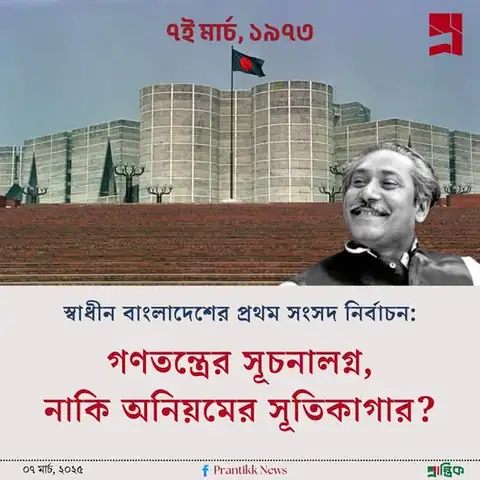
Bangladesh's first national parliamentary election after independence. March 7, 1973. A newly independent country, the public is floating in enthusiasm. But from the morning of that election day, abnormal things began to happen in various parts of the country. Opposition candidates could not find their polling agents, and many disappeared from their constituencies. Voters were standing in lines, but even before casting their votes, announcements came, "Awami League is leading by a massive margin."
On one hand, the first democratic exercise of a newly independent country, and on the other hand, allegations of irregularities raised on election day and after the announcement of results. The opposition called it—"a festival of vote robbery." The ruling party said—"this is the people's verdict." But what is the real truth? If the allegations of election irregularities and vote theft are examined, what emerges? Background The independent birth of Bangladesh took place after the great Liberation War of 1971. The constitution was enacted on December 16, 1972, with the aim of forming a democratic government for the new country.
Following that, the first parliamentary election was announced for March 7, 1973. This election was a historical milestone in the history of Bangladesh, where 14 political parties participated. The ruling Awami League, NAP (Muzaffar), NAP (Bhasani), CPB, JSD, and other parties entered the field with their manifestos. At that time, Bangabandhu Sheikh Mujibur Rahman's popularity was at its peak. In the Awami League's manifesto, the election was claimed to be a 'referendum' on 'Mujibism' and the constitution.
On the other hand, opposition parties NAP (Bhasani) and JSD said that if elected, they would formulate a democratic and 'pure' socialist constitution. Although there were differences of opinion among the participating parties, progressive and leftist trends were noticeable in politics at that time. This was clearly reflected in the manifestos announced by the parties for the '73 election. All parties participating in the election promised socio-economic improvement for ordinary people.
At that time, the public was somewhat dissatisfied due to the deterioration of the law and order situation and economic crisis. Besides, a few months before the election, Awami League split and a new party, JSD, was formed. Even after this, Awami League's victory was certain. First step of irregularity: Obstacle in nomination submission Whether the opposition parties would be able to enter the electoral field was the first question. There are allegations that in many places, opposition candidates were not even allowed to submit their nominations.
In Faridpur, K. M. Obaidur Rahman, in Bhola, Tofail Ahmed, in Magura, Sohrab Hossain and Motahar Uddin Ahmed—prevented opposition candidates from submitting nominations. In several constituencies of Sylhet, Awami League candidates' victory was ensured through rigging. Khandaker Mostaq Ahmad was elected through vote robbery in Cumilla. (Rise and Fall of JSD: Politics of Unstable Times, p. 98) Even after submitting nominations, many candidates were forced to withdraw their candidacies at the next stage.
In Rajshahi, A. H. M. Kamruzzaman, in Mymensingh, Rafiquddin Bhuiyan, in Kishoreganj, Syed Nazrul Islam, Zillur Rahman and Monoranjan Dhar—pressured opposition candidates to step down from the election. Yet Syed Nazrul Islam was the Vice-President of the exile government, and Kamruzzaman was a member of the first cabinet of independent Bangladesh. (Politics of Bangladesh-Halim Dad Khan, p. 47) What happened on polling day? On voting day, it was seen that opposition candidates' agents were absent in many centers. Ballot boxes were already full.
Although NAP candidate Mostaq Ahmad Chowdhury in Chattogram's 294th constituency was unofficially declared victorious, it was announced from state radio on the night of March 10 that he was defeated. Oli Ahad mentioned in his book National Politics, "In the general election of March 1973, aided by the gross misuse of administrative power, resort to extreme corruption, media coup, arbitrary aggressive attacks by party forces, and blanket threats, Prime Minister Sheikh Mujibur Rahman captured 292 out of 300 seats.
When I was on the path to a certain victory by a margin of 26 thousand votes, I was declared defeated by 10 thousand votes through radio and television." (National Politics - Oli Ahad, p. 464) In Tangail, NAP candidate Dr. Alim Al Razi, in Barishal, Major Jalil, Captain Sujat Ali, and Professor Muzaffar Ahmed's victory was certain, but they were made to lose.
Even in Bangabandhu Sheikh Mujibur Rahman's own constituency, the margin of victory was so small that at the last moment his vote count was increased from 1 lakh 5 thousand to 1 lakh 14 thousand (Politics of Bangladesh-Halim Dad Khan, p. 43). Misuse of government facilities The misuse of government power in the election was blatant and clear. Opposition candidates did not get any government facilities, whereas Awami League candidates campaigned using government cars.
Prime Minister Sheikh Mujib himself campaigned across the country using government transport, and ministers did the same. The opposition was not even given the opportunity to campaign on television or radio. Abul Mansur Ahmed wrote in his book, "Leaving aside speeches of opposition leaders on radio and television, they could not even campaign properly due to lack of transport. On the other hand, Prime Minister Sheikh Mujib started making hurricane tours all over the country. Ministers also took the facility of government transport."
(Fifty Years of Politics As I Saw It-Abul Mansur Ahmad, p. 626) Opposition reaction: Anger over rigging Immediately after the election, opposition parties raised one allegation of irregularity after another. In a JSD press conference on March 9, ASM Abdur Rab said in a written statement, "Polling agents of opposition candidates have been driven out, votes have been robbed, and there has been rigging in the announcement of results."
(Gonokantho, 10 March 1973; Rise and Fall of JSD: Politics of Unstable Times, p. 99) On the same day, a statement by the Communist Party said, "There are numerous allegations that in some seats where Awami League candidates faced strong contest, undemocratic activities contrary to a fair and free election have been carried out from the side of Awami League candidates."
(Sangbad, 11 March 1973; Rise and Fall of JSD: Politics of Unstable Times, pp. 99-100) NAP President Professor Muzaffar Ahmad and Secretary Pankaj Bhattacharya said in a joint statement on March 9, "In at least 70 constituencies where NAP and other opposition political parties had a sure chance of victory, the ruling party turned the election into a farce in those centers through extreme undemocratic activities like misuse of state power, rattling of weapons, fear, terror, use of goon squads, fake votes, capturing polling booths, kidnapping polling agents, misuse of foreign aid agencies, United Nations, government cars, and Red Cross cars, and forcibly defeated the opposition candidates."
(Sangbad, 10 March 1973; Rise and Fall of JSD: Politics of Unstable Times, p. 99) Election results In the first parliamentary election, candidates of the ruling party in 11 out of 300 seats were elected unopposed. Bangabandhu Sheikh Mujibur Rahman ran as a candidate in four seats and was elected unopposed in two seats.
The other nine elected unopposed were Sohrab Hossain, Tofail Ahmed, Motahar Uddin, K M Obaidur Rahman, A H M Kamaruzzaman, Rafiq Uddin Bhuiyan, Monoranjan Dhar, Syed Nazrul Islam, and Zillur Rahman. Government-backed newspapers had also predicted that opposition parties might get 15-20 seats. But after the results were published, it was seen that out of 289 seats, Awami League won 282 seats. Opposition parties won 2 seats and independent candidates won the remaining 5 seats.
Among the opposition parties, the victory of veteran Bangladesh National League leader Ataur Rahman Khan was notable. Voter turnout in this election was 55.62 percent. Awami League received 73.20 percent of the total valid votes. NAP (Muzaffar) received the second highest 8.33 percent votes. Then JSD got 6.52 and NAP (Bhasani) got 5.32 percent votes. Despite the possibility of certain victory in the election, Awami League's stance towards the opposition was quite strict.
Opposition parties claimed that even though opposition candidates were leading in the vote count in quite a few seats, they were ultimately not allowed to win. In this process, the declaration of victory for then Awami League leader Khandaker Mostaq Ahmad was widely discussed.
Regarding this, in the book 'Tajuddin Ahmed: Leader and Father', Tajuddin's daughter Sharmin Ahmed wrote, 'Although Awami League won the election, news that some leaders of the party won by rigging the election was published in some newspapers and I also heard that news from the discussions of elders. The news of rigging in several seats of Sylhet and Khandaker Mostaq stealing the win in Cumilla was not unknown to political circles at that time.' In the by-elections held in May 1973, Awami League lost two seats.
However, at that time, Awami League secured all 15 seats reserved for women in the national parliament. As a result, out of a total of 315 seats in parliament, the ruling Awami League's seat count was 306. Awami League's lack of confidence There was no chance of opposition victory in the election, but Awami League was confidence-less about its own victory. The situation reached such a point that if Sheikh Mujib held a rally at Suhrawardy Udyan, Bhasani would hold a rally at Paltan; people would debate whose rally had more people.
Abul Mansur Ahmed believes that this lack of confidence of the Awami League pushed them onto the path of irregularities. He thinks the opposition was overly enthusiastic about the election, and Awami League's excessive lack of confidence was not logical. But that lack of confidence pushed Awami League towards a managed election. What message does this election give to history? The election of March 7, 1973 was the first test of democracy, but Bangladesh could not succeed in that test.
Irregularities, vote robbery, and misuse of administrative power—the seeds of all these were sown right then. The continuity of that political culture can be seen in many subsequent elections. The latest continuity of which we can see in the elections of 2014, 2018, and 2024 during the tenure of Sheikh Mujibur Rahman's daughter Sheikh Hasina.
This story first appeared on the Prantik News Facebook page.