
Today is May 1st, International Workers' Day, a day of rights, solidarity, and struggle for working people
But how did May Day originate?
Machine-translated from Bangla. মূল খবর বাংলায় পড়ুন
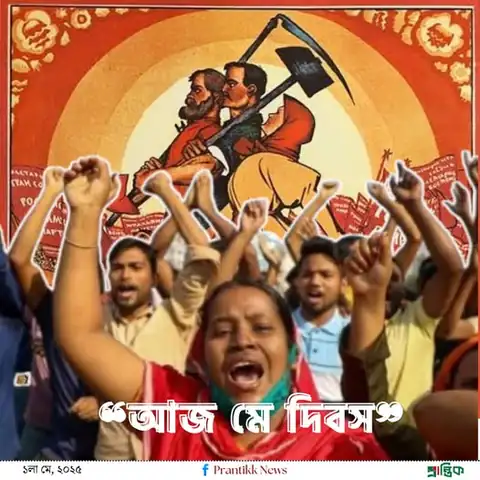
Today is May 1st, International Workers' Day—a day of rights, solidarity, and struggle for working people. But how did May Day originate? And why was the date of May 1st chosen? The answers to these questions can be found in the historical essay "What is the Origin of the Day?" written in 1894 by Marxist revolutionary and theorist Rosa Luxemburg. The idea of a workers' festival aimed at establishing an eight-hour workday first originated in Australia.
In 1856, the workers there decided to observe a full day of strike action demanding an eight-hour workday, which would include rallies and cultural events. This day was scheduled for April 21st. Initially, Australian workers planned this celebration only for the year 1856. But this very first celebration had such a profound impact on the Australian working-class community, inspired them, and sparked a new movement that it was decided to observe it every year.
In reality, what could be greater than a spontaneously adopted general strike to instill trust and courage in the workers' own strength? What could be more inspiring for the exploited workers of factories and workshops than a gathering of their own strength? Thus, the idea of a workers' festival quickly gained popularity, spread from Australia to other countries, and was eventually established across the entire working world. Following the Australian workers, American workers were the first to move forward on this path.
In 1886, they decided that May 1st would be the universal strike day. On this day, two hundred thousand workers stopped work and demanded an eight-hour workday. Later, due to police repression and legal harassment, workers could not organize such large-scale protests for many years. However, in 1888 they organized again and decided to hold the next protest on May 1st, 1890. Meanwhile, the labor movement in Europe had grown stronger and more dynamic.
Palpable expression of this movement occurred at the International Workers' Congress of 1889. In this congress, in the presence of four hundred delegates, it was decided to establish the eight-hour workday as the primary demand. Subsequently, Lavigne, a workers' representative from the city of Bordeaux representing French trade unions, proposed that this demand be presented through a simultaneous strike in all countries.
When the American labor delegate mentioned his fellow workers' decision to strike on May 1st, 1890, the congress fixed this date as International Workers' Day. In this case, just like Australia thirty years earlier, the workers had initially thought only of a one-time protest. The congress decided that on May 1st, 1890, workers of all countries would simultaneously protest for the eight-hour workday. No one spoke of repeating this day in subsequent years.
But no one could anticipate how this idea would achieve success with lightning speed and how rapidly it would be adopted by the global labor movement. However, observing May Day just once was enough for everyone to realize that it should become an annual and permanent tradition [...]. The core demand of the first May Day was the implementation of the eight-hour workday. But even if this goal is achieved, the importance of May Day will not diminish.
As long as the struggle of workers against the bourgeoisie and the ruling class continues, as long as all their demands are not met, May Day will remain the annual expression of these demands. Even when the working class achieves its emancipation, when a brighter day dawns for humanity, May Day will probably still be celebrated in memory of past bitter struggles and countless sacrifices. Date of composition: 1894 (first published in Polish in the newspaper Sprawa Robotnicza).
Publication: Rosa Luxemburg Speaks, edited by Mary-Alice Waters, Pathfinder Press, 1970 (or equivalent translated edition).
This story first appeared on the Prantik News Facebook page.