

Those who attack Tagore in the name of Islam do not actually believe in Islam's principle of beauty
Machine-translated from Bangla. মূল খবর বাংলায় পড়ুন
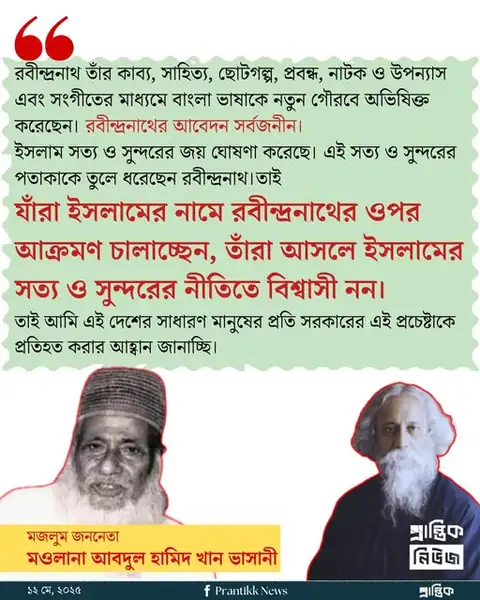
Tagore, as uttered by Bhashani, is actually a symbol of our integrated self-identity. In June 1967, Pakistan's Central Information Minister Khwaja Shahabuddin announced in the National Assembly that Rabindra Sangeet was against Pakistani ideology and would therefore be banned on radio and television. Denying Tagore's deep influence on East Pakistan's culture and national consciousness, it was said that this practice was contrary to Islamic values. East Bengal became agitated in protest against this declaration.
Numerous prominent intellectuals including Dr. Qudrat-e-Khuda, Sufia Kamal, Zainul Abedin, Munier Chowdhury, Shamsur Rahman, and Ahmed Sofa (Sharif) united and issued a statement. Yet on the other side was a head-of-state-backed "anti-Tagore alliance" which wanted to deny Tagore and project Nazrul as the symbol of "Pakistani lifestyle and ideology." In this volatile time, ailing from the hospital, Maulana Abdul Hamid Khan Bhashani issued a historic statement.
He said: "Through his poetry, literature, short stories, essays, plays, novels, and music, Tagore has glorified the Bengali language anew. Tagore's appeal is universal. Islam has proclaimed the victory of truth and beauty. Tagore has raised the banner of this truth and beauty. Therefore, those who attack Tagore in the name of Islam do not actually believe in Islam's principles of truth and beauty."
(Source: Daily Pakistan, June 1967) This statement by Bhashani was not merely in favor of the practice of literature, but also a strong stance in favor of a secular and rational Muslim mindset. His statement proves that the malicious attempt to label Tagore as "un-Islamic" is not just political, it is a stance against the truth of history and culture. This statement serves as an institutional alternative voice against anti-Tagore sentiment—standing in favor of secularism, communal harmony, and cultural self-identity.
Today, when similar factional attacks have begun once again against Tagore, this history-infused statement of Bhashani becomes even more relevant. On one hand, it is a recognition of Tagore's universality and secularism, and on the other hand, it exposes the true face of the groups spreading propaganda in the name of Islam.
This story first appeared on the Prantik News Facebook page.