
Two deaths in the same sport: The world stops and weeps at one, stone-cold silence at the other
Two deaths in the same sport, but the world stops and weeps at one, while there is stone-cold silence at the other
Machine-translated from Bangla. মূল খবর বাংলায় পড়ুন
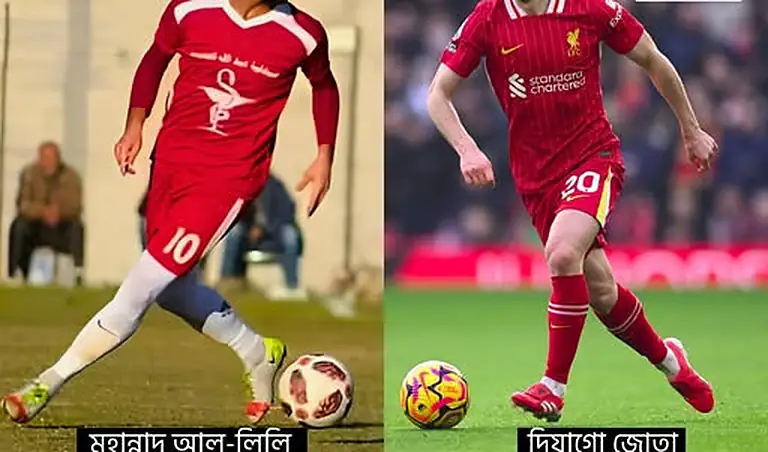
Two deaths in the same sport—yet at one the world stops and weeps, while at the other there is a stone-cold silence. Diogo Jota was a footballer for the Portugal national team and the heartbeat of Liverpool in club football. Following his death in a sudden road accident, a wave of grief descended worldwide. Clubs, federations, teammates, and spectators all remembered him and wept. FIFA and UEFA also paid their respects. This is a just grief, about which there is no doubt.
At the same time, however, Palestine national team footballer and Al-Maghazi Services Club captain Muhannad Fadl Al-Lili was killed in an Israeli airstrike. This was not an accident, but rather the death of a footballer who fell victim to planned state violence. But he is not the first Palestinian footballer killed in this ongoing genocide; he is at least the 265th Palestinian footballer. Yet, there is no reaction anywhere regarding his death. There are no messages of condolence, no moments of silence. There is not a single statement from FIFA or UEFA. The global media is also silent.
As football remains relevant as a game of the masses, it has never been outside of politics. Although it spread from Europe, the center of football still revolves around Europe today. While the game goes on, the control of discrimination over who is "human" and who is "enemy" outside the game also originates from that center. Not just the pitch, but news headlines, expressions of grief, and reactions—all seem to follow an imperial script. If anyone raises a Palestinian flag on the pitch in Europe, they face fines or punishment, but one can stand up for Ukraine without any hesitation.
Where football could have become a space for human solidarity, the architects of war are now making room there under sponsor and military patronage. We saw a practical example of this in the context of the deaths of Diogo Jota and Muhannad Fadl Al-Lili. This silence is not mere indifference, but rather a planned bias. Where even grief is determined by class, race, geography, and politics.
The way the sporting world took a stance against apartheid in South Africa, and the way Russian clubs and players were banned as soon as the war in Ukraine began, are all proof of this. Then why this silence in the case of Palestine? Are Palestinian footballers outside the scope of human dignity? In fact, football, the game of the masses, is part of various other games outside the pitch, which corporate and imperial forces are pocketing.
The ruling elites of Europe know and accept very well that war is necessary to keep the economy running through the dominance of the arms industry. Consequently, it is clear how culture and sports are being used to sustain it. As a result, European and American players remain "human," while players from Gaza remain merely a statistic. The death of Muhannad Al-Lili is therefore not just the death of a player, it is a blow against the identity of a nation. Because the occupiers know—sports can also be a language of resistance.
The death of a European footballer brings the whole world to a halt, yet the death of a Palestinian player seems irrelevant. This discrimination points out to us that grief is also a political weapon. Today, if we want a minute of silence for Muhannad Al-Lili, it will not be just a tribute. Rather, it will be the declaration of a different human stance, a resistance of a sense of justice—which will say: all deaths demand mourning, all lives hold equal dignity.
This story first appeared on the Prantik News Facebook page.